if,  ,
,
 |
=  |
 |
=  |
Z-transform:
![$\displaystyle F^{*}\left[s=\frac{1}{T}ln \; z\right]$](../lec1/images/img22.png) |
= |
 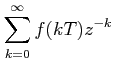 |
F(z), is the Z-transform of f(t) at the sampling instants k
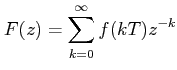
In general, we can say that if f(t) is Laplace transformable then it also has a Z-transform.
![$\displaystyle L[f(t)]$](../lec1/images/img29.png) |
=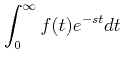 |
![$\displaystyle Z[f(t)]$](../lec1/images/img31.png) |
= |