2. Revisiting Z-Transforms
Z-transform is a powerful operation method to deal with discrete time systems. In considering Z-transform of a time function x(t), we consider only the sampled values of x(t), i.e., x(0), x(T), x(2T)........... where T is the sampling period.
![$\displaystyle X(z)=Z[x(t)]$](images/img35.png) |
= ![$\displaystyle Z[x(kT)]$](images/img36.png) |
= 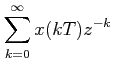 |
For a sequence of numbers x(k)
 |
= ![$\displaystyle Z[x(k)]$](images/img40.png) |
=  |
The above transforms are referred to as one sided z-transform. In one sided z-transform, we assume that x(t) = 0 for t < 0 or x(k) = 0 for k< 0. In two sided z-transform, we assume that
- ∞ < t < ∞ or k = , ±1,±2, ±3, ................
|
= |
= 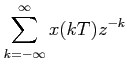 |
or for x(k)
|
= |
= 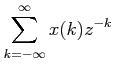 |