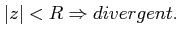
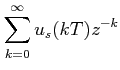
The one sided z-transform has a convenient closed form solution in its region of convergence (ROC) for most engineering applications. Whenever X(z), an infinite series in z -1, converges outside the circle  , where R is the radius of absolute convergence, it is not needed each time to specify the values of z over which X(z) is convergent.

In one sided z-transform theory, while sampling a discontinuous function x(t), we assume that the function is continuous from the right, i.e., if discontinuity occurs at 0 we assume that x(0) = x(0+).
2.1 Z - Transforms of some elementary functions
Unit step function is defined as: |
 for for |
|
 for for |
Assuming that the function is continuous from right
 |
 |
 |
|
|
 |
||
|
 |
||
|
 |
||
|
 |