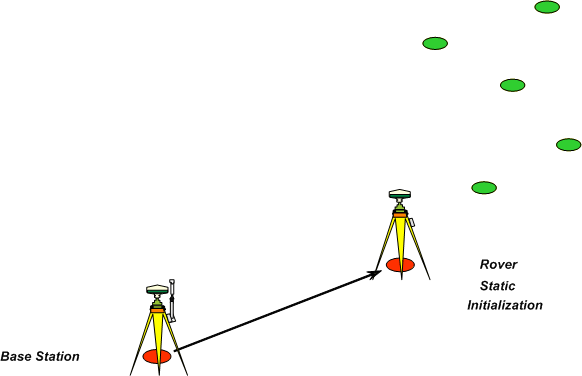
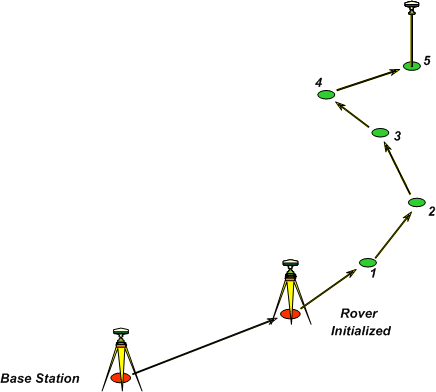
Requires at least one stationary receiver and at least one other rover, all observing the same set of satellites simultaneously. The reference receiver occupies same position throughout whereas the rover stops for a while at occupied positions.
The method has the following charactersistics in the stop and go mode (Figure 12.6 (a) and (b)):
Stop Mode
Before the start of the survey, the rover must resolve the ambiguities.
Ambiguity resolution is carried out by generally two techniques (explained later):
Static initialization
Initialization on a known point
The reference station must
continuously track at least 4 satellites without signal loss. Also the configuration should have good GDOP (strong satellite constellation needed) and favorable ionospheric conditions.
Figure 12.6 (a) Stop mode in stop and go method
Go Mode
Once enough data is collected to resolve the ambiguities, user can now move the receiver
Lock must be maintained on a minimum of 4 satellites at all time
Each point visited (starting from 1, 2, 3, etc.) requires only 2 epochs of data
If lock is lost, the system must be re-initialized
Accuracy ± ( 10-20 mm + 1ppm)
Applications Detail and engineering surveys in open areas
Drawbacks New static or rapid static fix is needed if complete loss of lock.occurs