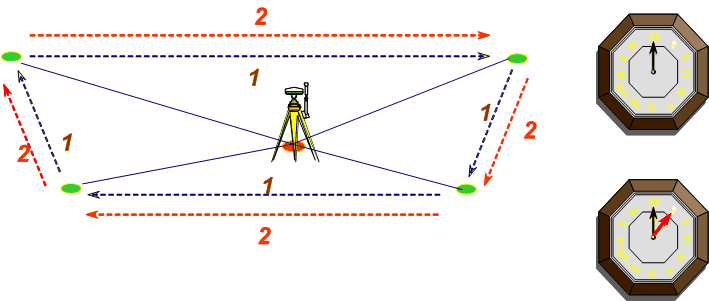
(c) Reoccupation (pseudo-kinematic and pseudo-static or intermittent static)
Similar to standard kinematic procedures and static procedures combined. Hence, also called pseudo-kinetic and pseudo-static or intermittent static.
Differences with standard kinematic are:
Reoccupation does not require static initialization
Reoccupation requires longer period of time at each point (typically 1-10 minutes)
Each point must be revisited after about at least an hour and preferably after more than 4 hours
In reoccupation, the number of satellites does not play essential part and loss of satellite lock is acceptable (receiver may be turned off while moving)
Positional error is more than for kinematic or rapid static procedures, hence less acceptable method for establishing baselines.
For a given observation time, more sites are occupied than with conventional static.
Reference station tracks continuously on a known point
wheras the roving receiver spends a short period on each point
After one hour each point is reoccupied for a short period of time (1-10 minutes), Figure 12.4 shows an exqmple of reoccupation where for a reference receiver, four sites are occupied at different interval of time (after one hour).
Figure 12.4 Reoccupation method of GPS surveying
Accuracy : ± (5-10 mm + 1 ppm); 1:50,000 to 1:500,000. Higher accuracies are possible in this method primarily as a result of changed satellite configuration during reoccupation
Site must be revisited, hence useful for local applications only. For example,
photo control
lower order control surveys
mining surveys
preferable if points are easily accessible in a small area (excellent if along roads)
Ideal method when conditions are not suitable for rapid static surveys. For example, fewer than 4 satellites are available or when GDOP is poor (more than 7 or 8). It allows the satellites at second occupation to have configuration different than the first for ambiguity resolution. In fact, the rapid static method is a competitor for this technique.
Obviates the need of continuous lock on satellites (unlike other kinematic methods) and allows to cover more stations than static surveys.