| (b) Rapid static or fast static survey
|
- To measure short baselines (up to 15 km) and determine positions in the centimeter level with short observation times (5-20 min).
- Observation time is dependent on (a) length of the baseline (b) number of visible satellites
- No continuous locking is required with moving rover from one station to the next since each baseline is processed independent of each other. In fact, receivers can be turned off to preserve batteries (though not recommended).
- This method is a combination of the stop-and-go kinematic, pseudo-kinematic, and static surveying methods (explained later).
- It may be noted that the initial phase ambiguities can be resolved within a minute for a dual frequency receiver (3-5 minutes for single frequency receivers).
Hence, special and sophisticated hardware with expensive receivers (dual frequency) may be required in this method with
- either cross correlation or squaring or any other technique used to compensate for AS.
- capability to combine code and carrier phase measurements from both frequencies
- The method does not require re-observation of remote stations like pseudo-kinematic or reoccupation method.
- Similar to static but uses a special technique called wide laning (explained in Lecture 15) to provide almost same accuracies as with static surveys with reduced observation time.
- Accuracies : Similar to static: ± (5-10 mm + 1 ppm); 1:100,000 to 1:1,000,000
- Applications
- Control Surveys
- GIS city inventories
- Detail surveys
- Replace traversing and local triangulation
- Any job where many points have to be surveyed
- Advantages
- Easy, quick, efficient
- Ideal for short range survey
- Conserves battery power
|
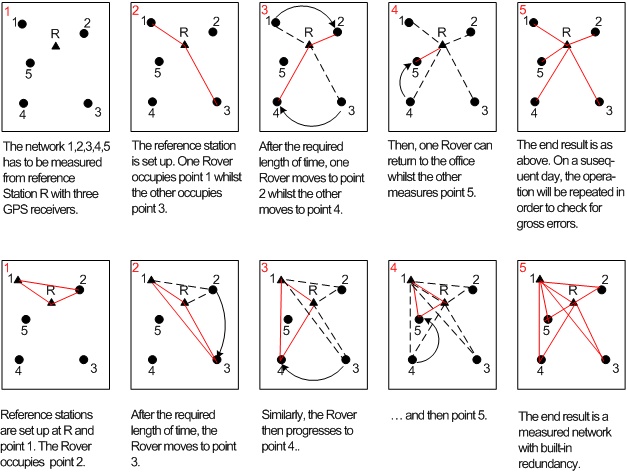
| A typical rapid static session is explained in Figure 12.2 where a network with rover stations 1, 2, 3, 4, 5 has been establsihed with R as the reference station. |
|
Figure 12.2 A typical rapid static survey (GPS Basics, 2001)
|
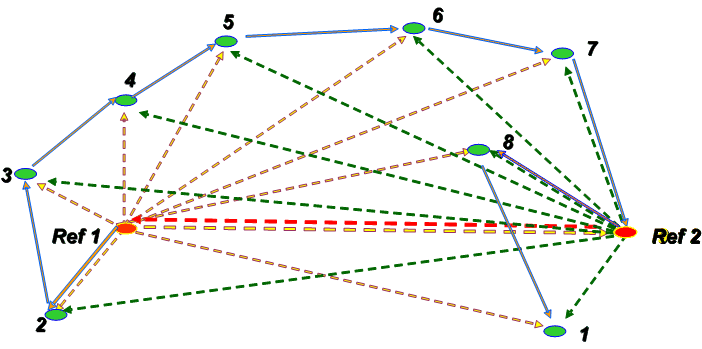
| A typical rapid static survey can be carried out with (a) 1 Reference and 1 Rover or (b) 2 Reference and 1 Rover (Figure 12.3). In 1 Reference and 1 Rover approach also known as the leap frog method, instead of either of the receivers remaining motionless reference throughout the survey, they move one at time, i.e. receivers take roving in turn.
|
| |
|
Figure 12.2 Rapid static survey with two reference receivers and one roving receiver
|
| |
|