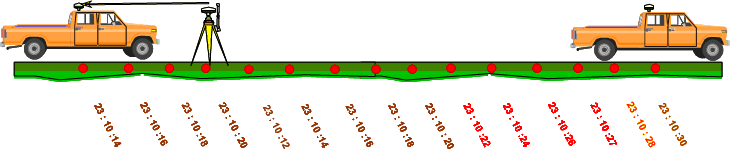
Allow user to rapidly and accurately measure baselines while moving from one point to the next. Sometimes also called dynamic surveying.
Collected data can be post-processed to obtain accurate positions to centimeter level.
Permits only partial loss of satellite lock during observation and requires a brief period of static initialization .
On the Fly (OTF) technology (explained later), both real-time and post-processed, could eventually replace standard kinematic procedures at least for short baselines.
Accuracy : ± ( 10-20 mm + 1ppm); 1:100,000 to 1:750,000
Observation time: 1 to 4 epochs (1 to 2 minutes on control stations; faster the rover speed, shorter the epochs).
Fast data sampling receivers are required (0.5 to 5 sec); very fast sampling rate is required for works requiring continuous motion
Initialization by (a) occupying two known station for 2 to 5 minutes or (b) antenna swap method
General requirements for kinematic surveys
Lock must be maintained for a set of satellites in use.
Occupied points should be free from obstruction otherwise loss of lock may occur. This method is advisable in open areas to collect high accuracy topographic data.
Hence, advance planning of survey area is required to have it clear of obstruction to avoid loss of lock. In case the lock is lost, one can start from the last trouble free station or return to occupy known baseline. It is advisable to use a minimum of 5 satellites against 4 as a guard for loss of lock.
Receiver may also need bandwidth selection capability. It may be noted that wideband signal transmitted by satellites provides anti-jamming capability and high resolution ranging. After reception, the so called "spread spectrum signal" is compressed or despread into a smaller bandwidth by demodulating it with an identical waveform. The choice to set narrow bandwidth allows better signal-to-noise ratio (SNR) at the cost of less secure signal lock requiring some trade-off (Sickle, 2001).
Kinematic surveys involve two modes - first the stop mode followed by the moving mode. These modes have the following characteristics (Figure 12.5):
Stop Mode
The rover must first be initialized
Moving Mode
Once enough data is collected to resolve the ambiguities, user can now move the receiver
by maintaining the lock on a minimum of 4 satellites at all time
While moving the rover records data at a specific time interval
If the lock is lost, the system must be re-initialized