5-5.7. Vector design for chloroplast transformation
5-5.7.1. Selectable marker genes
Due to the presence of multi-copy plastid DNA, selectable marker genes are very important to achieve uniform transformation of all genome copies. The non-transformed plastids are gradually left out during an enrichment process using a selective medium. Initially plastid 16S rRNA (rrn16) gene was used as a selection marker in chloroplast transformation. The transgenic lines were selected by spectinomycin resistance but with low efficiency.
Various selectable markers for chloroplast transformation have been developed based on various features like dominance, cell-autonomy or portability (listed in Table 5-5.7.1.).
- Dominant markers confer high transformation efficiency due to the expression at early stages although present in a minority of the plastomes. e. g. aadA (aminoglycoside 3′adenylyltransferase) gene confers resistance to streptomycin and spectinomycin by inactivation of antibiotics.
- Recessive markers confer lower transformation efficiency. They confer resistance only when enough transformed plastome copies are produced by random segregation resulting in a selectable phenotype. e. g. point mutation in the ribosomal RNA, rrnS and rrnL genes, confer antibiotic resistance by relieving the sensitivity of individual ribosome.
- Plastid- or cell-autonomous markers confer their phenotype only to the organelle or the cell in which they reside. Some markers may integrate at a specific locus of the plastid genomee.g. rrnS or rrnL genes.
- Autonomous and portable markers can be inserted virtually in any locus of the plastome e.g. aadA gene.
- Some markers have a property to confer a phenotype strong enough for direct selection of transformants.
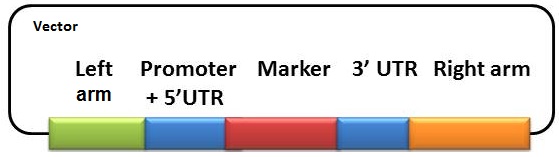
Figure 5-5.7.1: Selectable marker (in case when it is a foreign gene to be inserted into plastid genome shown in red) is under the control of expression signals such as promoter, a 3 ̍ UTR and a 5 ̍ UTR (shown in blue).
(Adapted from Day A and Clermont MG. 2011. The chloroplast transformation toolbox: selectable markers and marker removal. Plant Biotechnology Journal 9, 540–553)