5-5.4.3. Homologous recombination
- Chloroplast transformation involves homologous recombination and is therefore precise and predictable.
- This minimizes the insertion of unnecessary DNA that accompanies in nuclear genome transformation.
- This also avoids the deletions and rearrangements of transgene DNA, and host genome DNA at the site of insertion.
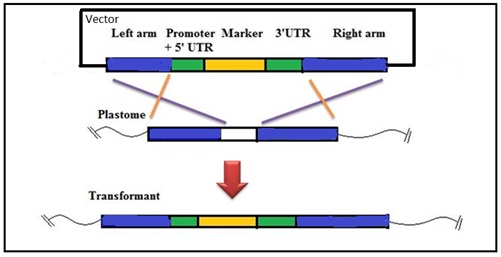
Figure 5-5.4.3: A vector containing a selectable marker (yellow) under the control of plastid expression signals (promoter, 5 ̍ UTR and 3 ̍ UTR , shown in green) flanked by chloroplast sequences (shown in purple). Homologous recombination takes place between the flanking targeting arms and recipient plastid genome (plastome).
(Adapted from Day A and Clermont MG. 2011. The chloroplast transformation toolbox: selectable markers and marker removal. Plant Biotechnology Journal 9, 540–553)
5-5.4.4. Gene silencing/ RNA interference
Gene silencing or RNA interference does not occur in genetically engineered chloroplasts.