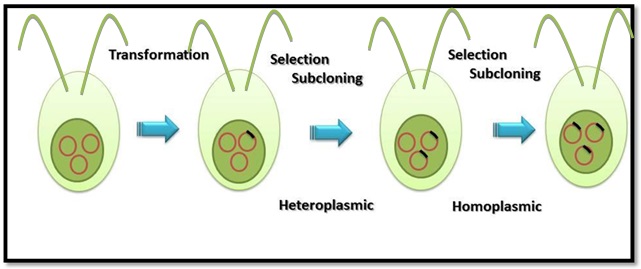
Figure 5-5.3.1: Chloroplast transformation in Chlamydomonas: Chlamydomonas comprises a single large chloroplast with about hundreds of copies of its genome. Initial integration occurs in only one copy of the polyploid plastome resulting in heteroplasmic. Repeated sub-cloning and selection result in recovery of homoplasmic clones.
(Adapted from Day A and Clermont MG. 2011. The chloroplast transformation toolbox: selectable markers and marker removal. Plant Biotechnology Journal 9, 540–553)
5-5.4. Advantages of chloroplast transformation
Chloroplast transformation offer several advantages compared with nuclear transformation which are as follows-
5-5.4.1. Risk of transgene escape
Chloroplast genome is maternally inherited and there is rare occurrence of pollen transmission. It provides a strong level of biological containment and thus reduces the escape of transgene from one cell to other.
5-5.4.2. Expression level
- It exhibits higher level of transgene expression and thus higher level of protein production due to the presence of multiple copies of chloroplast transgenes per cell and
- Remains unaffected by phenomenon such as pre or post-transcriptional silencing.