Glycan maturation in the Golgi: In golgi bodies both trimming and addition of sugar molecules takes place which generates diversity in glycan structure of glycoproteins. Up to previous step of trimming in ER, glycan structure of all proteins is same. In golgi bodies, each cisternae carries specific enzyme and step-wise processing occurs. The ultimate glycan structure can be majorly classified in two catagories. Complex oligosaccharides – contain multiple sugar types.
High-mannose oligosaccharides – multiple mannose residues
Hybrid – branches of both high mannose and complex oligosaccharides
When the glycan is accessible to Golgi mannosidase I and II it forms complex oligosaccharide as given in Figure 31.4. These enzymes cut off several mannose residues and then get glycosylated by GlcNAc transferase. This process results in formation of common core region. After this, via several Gtfs, multiple sugar moieties are added to the core which could be of variable length or could be branched also. These variable length chains or branched chains commonly include sugars such as GlcNAc, galactose (Gal), N-acetylneuraminic acid (NANA or sialic acid) and fucose. Complex oligosaccharide is resistant to endoglycosidase H (endo H) unlike high mannose containing glycan, and thus forms the basis of differentiating the two categories of glycan. High mannose oligosaccharide has high mannose content and do not carry other sugar moieties. Apparently, conformation of glycoproteins is such that enzymes required to process glycan to form complex oligosaccharide are inaccessible. There are certain glycoproteins that have hybrid oligosaccharides, including a combination of complex and high-mannose glycans,
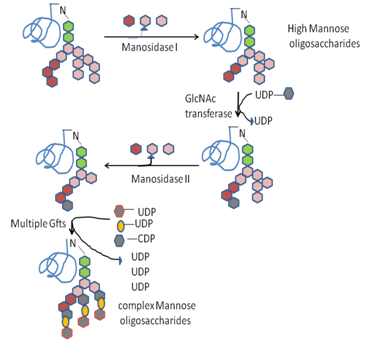
Figure 31.4: Glycon maturation