| |
Diamagnetism, being a consequence of Lenz's law is present in all substance though its effect may be masked because of other strong magnetic effects. However, certain substances like Bismuth are strongly diamagnetic. The effect arises because when an atom is placed in a magnetic field, the flux through the atomic orbit changes. This results in an induced current being generated which opposes the changing flux. The effect is equivalent to the atom developing an induced magnetic moment opposite to the direction of the applied field. |
| |
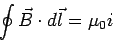
We have seen that the magnetic field due to a current is given by Ampere's law |
| |
where the current passes through the surface of the boundary over which the above integral is taken. Maxwell pointed out that the equation is logically inconsistent.
Consider a parallel plate capacitor being charged by a battery. During the process of charging a current passes through the terminals of the battery. The current produces a magnetic field around it. Consider an Amperian loop  located just outside one of the plates. Let the plane of the loop  be parallel to the plates. On applying Ampere's law to such a loop, we get the value of the above integral to be non-zero as there is a current passing through the wires. However, consider a second surface  which is located just inside the plates of the capacitor and does not intersect the wire at all. The flux of the current (the the surface integral of the current density) through this surface is zero. However, as both and are bounded by the same loop , the flux through both must be the same. This is clearly inconsistent. |