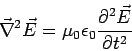
| |
Wave Equation in Three Dimensions |
| |
We can obtain the wave equation in three dimensions by using eqns. (1) to (4). On taking the curl of both sides of eqn. (3), we get |
| |
Using the operator identity |
| |
wherein we have used  , and substituting eqn. (4) we get , and substituting eqn. (4) we get |
| |
A three dimensional harmonic wave has the form 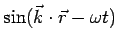 or or 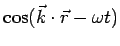 Instead of using the trigonometric form, it is convenient to use the complex exponential form Instead of using the trigonometric form, it is convenient to use the complex exponential form |
| |
and later take the real or imaginary part of the function as the case may be. The derivative of  is given as follows : is given as follows : |