| |
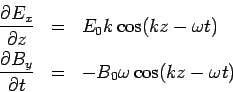
The amplitudes  an an  are not independent as they must satisfy eqns. (5) and (6) : are not independent as they must satisfy eqns. (5) and (6) : |
| |
The ratio of the electric field amplitude to the magnetic field amplitude is given by |
| |
Fields  and and  are in phase, reaching their maximum and minimum values at the same time. The electric field oscillates in the x-z plane and the magnetic field oscillates in the y-z plane. This corresponds to a polarized wave . Conventionally, the plane in which the electric field oscillates is defined as the plane of polarization. In this case it is x-z plane. The figure shows a harmonic plane wave propagating in the z-direction. Note that are in phase, reaching their maximum and minimum values at the same time. The electric field oscillates in the x-z plane and the magnetic field oscillates in the y-z plane. This corresponds to a polarized wave . Conventionally, the plane in which the electric field oscillates is defined as the plane of polarization. In this case it is x-z plane. The figure shows a harmonic plane wave propagating in the z-direction. Note that  and the direction of propagation and the direction of propagation  form a right handed triad. form a right handed triad. |