| |
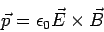
Since the direction of momentum must be along the direction of propagation of the wave, the above can be converted to a vector equation |
| |
If an electromagnetic wave strikes a surface, it will thus exert a pressure. Consider the case of a beam falling normally on a surface of area  which absorbs the wave. The force exerted on the surface is equal to the rate of change of momentum of the wave. The momentum change per unit time is given by the momentum contained within a volume which absorbs the wave. The force exerted on the surface is equal to the rate of change of momentum of the wave. The momentum change per unit time is given by the momentum contained within a volume  . The pressure, obtained by dividing the force by A is thus given by . The pressure, obtained by dividing the force by A is thus given by |
| |
which is exactly equal to the energy density  . . |
| |
If on the other hand, the surface reflects the wave, the pressure would be twice the above value. |
| |
The above is true for waves at normal incidence. If the radiation is diffuse, i.e., if it strikes the wall from all directions, it essentially consists of plane waves travelling in all directions. If the radiation is isotropic, the intensity of the wave is the same in all directions. The contribution to the pressure comes from those waves which are travelling in a direction which has a component along the normal to the surface. Thus on an average a third of the radiation is responsible for pressure. The pressure for an absorbing surface is  while that for a reflecting surface is while that for a reflecting surface is  . . |
| |
The existence of radiaton pressure can be verified experimentally. The curvature of a comet's tail is attributed to the radiation pressure exerted on the comet by solar radiation. |