|
The magnetization current is called bound current because the electron is not free to move through the material as they would in a conductor, but are attached to a particular atom or molecule. |
| |
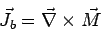
If, however, the magnetization is not uniform within the sample, the internal currents do not cancel and a magnetization current exists even in the bulk. It can be shown that the bound current density  is given by is given by |
| |
Ampere's Law in Presence of Magnetization |
| |
Since magnetization of a material produces bound current, it would modify Ampere's law for magnetic field. Consider a solenoid wound around a hollow cylinder with  turns per unit length carrying a current turns per unit length carrying a current  . The magnetic field in the solenoid is uniform and is given by . The magnetic field in the solenoid is uniform and is given by  . If now, a magnetic material is inserted in the hollow of the cylinder, the material gets magnetized with a magnetization . If now, a magnetic material is inserted in the hollow of the cylinder, the material gets magnetized with a magnetization  . The surface current density . The surface current density  has a magnitude has a magnitude  and has the dimension of current per unit length. and has the dimension of current per unit length. |
| |
A unit length of the solenoid has an effective current given by the sum of free current  and the magnetization current . Ampere's law would then give the magnetic field in the solenoid as and the magnetization current . Ampere's law would then give the magnetic field in the solenoid as |