| |
Since only  , this implies , this implies |
| |
Thus  is independent of is independent of  coordinate and can be written as coordinate and can be written as  . A similar analysis shows that . A similar analysis shows that  is independent of is independent of  coordinate and can be written explicitly as coordinate and can be written explicitly as  . . |
| |
Consider now the time dependent equations eqns. (3) and (4). The curl equation for  gives, taking z-component gives, taking z-component |
| |
showing that is independent of and hence depends only on  and and  . In a similar manner we can show that also depends only on and . Thus the fields . In a similar manner we can show that also depends only on and . Thus the fields  and do not vary in the plane containing them. Their only variation takes place along the z-axis which is perpendicular to both and . The direction of propagation is thus and do not vary in the plane containing them. Their only variation takes place along the z-axis which is perpendicular to both and . The direction of propagation is thus  direction. direction. |



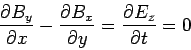
 , this gives

