| |
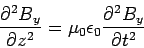
To get the wave equation for  , take the derivative of eqn. (5) with respect to , take the derivative of eqn. (5) with respect to  and substitute in eqn. (6) and interchange the space and time derivatives, and substitute in eqn. (6) and interchange the space and time derivatives, |
| |
Similarly, we can show, We get |
| |
Each of the above equations represents a wave disturbance propagating in the z-direction with a speed |
| |
On substituting numerical values, the speed of electromagnetic waves in vacuum is  m/sec. m/sec. |
| |
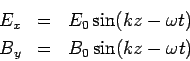
Consider plane harmonic waves of angular frequency  and wavlength and wavlength  . We can express the waves as . We can express the waves as |