Delay Analysis for the FCFS M/M/m/∝ Queue
We consider two cases - one where the arrival finds at least one server idle so that it can start service immediately and the other where the arrival finds all the severs busy and has to wait in the buffer until it can be served.
(a) Arriving Customer Finds a Server Free (i.e. number in the system less than m)
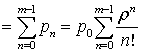
In this case, the queueing time is zero with probability given by
P{queueing time = 0}
(b) Arriving Customer Finds all Servers Busy (i.e. number in the system is m or more)
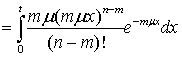
In this case, if the arrival finds n jobs in the system, n≥m, then it has to wait for n-m+1 service completions (each of which will be exponentially distributed) before its service can start. Using the result given earlier for the Erlang-n distribution (i.e. it arises out of the sum of n identically distributed exponential random variables) , we get
P{queueing time ≤t | arrival found n in system }
= P{(n-m+1) service completions in (0,t) }
Delay Analysis for the FCFS M/M/m/∝ Queue
Therefore, we can derive the cdf of the queueing delay Q as

This can be simplified by explicitly summing the first term and interchanging the order of the integration and summation in the second term. Differentiating this will then give the pdf of the queuing delay as

where δ(t) denotes the delta function and u(t) the unit step function.
Once we know the pdf of the queueing delay Q, the pdf of the total time W spent in the system by an arrival may be obtained as before by using the fact that W = Q+T where T is the time spent serving the job. This will be given by -
