M/M/m/m Queue (m server loss system, no waiting)
This queue has m servers but does not have any additional waiting positions. Therefore, arrivals coming when all the m servers are busy are not allowed entry to the queue and have to leave without service. This is a queue which has been commonly used to model a telephone exchange with m outgoing lines, each representing a server.This implies that the arrival process has rate λ for states k=0,1,.....,(m-1) but is zero for k=m. The service rate is kμ for k=0,1,......,m
λk = λ 0 ≤ k < m
= 0 otherwise (i.e. arrivals are blocked and do not enter the queue)
μk = kμ 0 ≤ k ≤ m
= 0 otherwise (does not really matter as the state never gets higher than m)
This queue will always be stable as arrivals which find all servers engaged leave without service. The state probability distribution for this queue may be found by any of the methods mentioned in the earlier lecture and are given below.
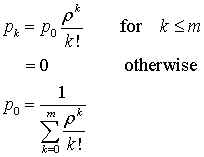
M/M/m/m Queue (m server loss system, no waiting)
In this queue, users arriving when all servers are busy leave without service. This event is referred to as blocking and its probability B(m, ρ) is the blocking probability of the queue for m servers and an offered traffic of ρ erlangs.
Blocking Probability B(m, ρ ) = P{an arrival finds all servers busy and leaves without service}
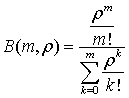
B(m,ρ) is also referred to as Erlang's B-Formula and can be found in standard probability tables. A simple recursion which may be conveniently used to calculate this is given below.