Therefore,

and 
For future reference, it is useful to note that the sum of n identical exponentially distributed random variables, eachwith mean 1/μ, has the Erlang-n distribution with its pdf given by the following -

For a M/M/1/∞ queue with FCFS service, consider a particular customer/job arrival of interest.
Since the arrival process is Poisson, the PASTA property mentioned earlier assures us that the state distribution as seen by this arrival will be the same as the time averaged (ergodic values) pk, probability of the system being in state k, obtained earlier. The probability of the arrival of interest finding k jobs already in the system will therefore also be pk. This also implies that the mean number N in the system and the mean number NQ waiting in the queue as seen by the arrival of interest will also be the same as the corresponding time averaged values obtained earlier for this queue.
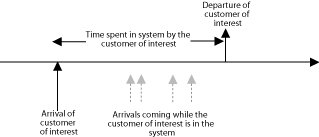 |
Note that since the queue is FCFS, the number seen left behind in the system by a departing job are the jobs which came while it was in the system. |
|---|---|
Arrival/Departure of Customer/Job of Interest from a FCFS M/M/1Queue |
|
|
|