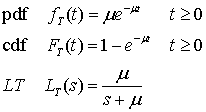
The service time T is exponentially distributed with mean 1/μ. Its pdf, cdf and the Laplace Transform of its pdf are given below.
It is also evident that the random variables W, Q and T will be related to each other as W=Q+T and that the random variables Q and T will be independent of each other (i.e. Q⊥T). Therefore, we get that
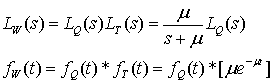
Note that * represents the convolution operation in the above equation
From the above, we can see that knowing the distribution of either W or Q, the distribution of the other may be found. Note that finding either the pdf, cdf or the LT of the pdf of a random variable is enough as the other quatitites may be found if we know any one of these quantities!
For a particular arrival of interest -
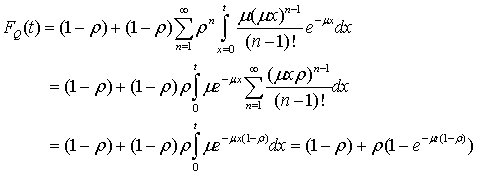
FQ(t) = P{ queueing delay ≤ t }
= P{ queueing time=0} + [ ∑ n≥ 1P{ queueing time ≤ t | arrival found n jobs in system}] pn