M/M/m/∞ Queue ( m servers, infinite number of waiting positions)
The arrival rate of jobs remains the same, i.e. λ, regardless of the state of the system. However, if the system is in state k, then the service rate is kμ when k ≤ m but it is mμ otherwise.
λk = λ ∀k
μk = kμ 0 ≤ k ≤ (m-1)
= mμ k ≥ m
The equilibirum solution for this system will exist if the offered traffic ρ = λ/μ < m. In that case, the equilibrium state probabilities can be calculated by any of the methods suggested earlier and will be as follows.
| For ρ=λ/μ < m |
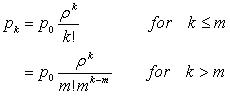 |
|
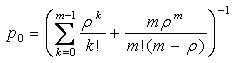 |
For a system with m servers where the offered load is ρ erlangs, the probability that an arriving customer has to wait for service is the probability that the system is in state m or higher. This probability, C (m,ρ) is also referred to as Erlang's C-Formula and is generally available in tables of probabilities.
| Erlang's C-Formula |
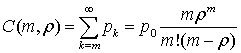 |
|---|
P{queueing } = C (m,ρ)
Note that in this queue, customers who get blocked because they find all servers busy when they arrive are held waiting in buffer until they can be served. For this reason, this is also referred to as a Blocked Customers Held (BCH) queue. This queue has also been used to model early telephone systems where operators would tell customers to wait in case all outgoing lines were engaged.