Consider a random variable which takes on the values n = 0,1,2, ......... with probabilities pn. The Generating Function G(z) of this discrete random variable is defined to be 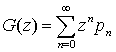 . Note that the mean value of this random variable is
 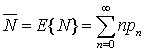 by definition. This may also be obtained using the generating function G(z) as
 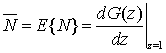 . This should be noted for future reference as a lot of our derivations will use these results.
Consider once again the arrival/departure of a particular job of interest that we were examining in the previous slide.
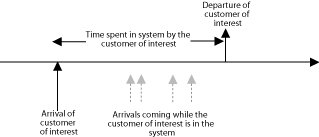 |
Note that since the queue is FCFS, the number seen left behind in the system by a departing job are the jobs which came while it was in the system. |
|---|---|
Arrival/Departure of Customer/Job of Interest from a FCFS M/M/1Queue |
|
The generating function G*(z) of the number N* that it will see left behind in the queue when it departs will then be given as
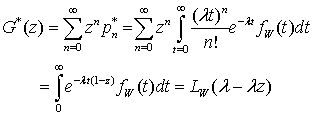
This may be used to find the mean number in the system left behind by a departing customer as

This is not unexpected as the arrival of interest will spend a mean time W in the system and the mean number of arrivals in that time will be λW.