M/M/1/-/K Queue ( Single server queue with infinite number of waiting positions serving a finite customer population K )
We assume that the total user population is finite and that a user which has created a job for the queue does not generate another one until the earlier one is served. We have assumed an infinite buffer but actually only a buffer of size K-1 is required. The server serves at rate μ with an exponentially distributed service duration whenever a job is getting served (i.e. system is not empty).
μk =μ k=1, ........, K
We assume that each user capable of generating a new job (i.e. a user which is neither waiting for service nor getting served) generates arrivals from a Poisson process with rate λ. When the system is in state k (i.e one job getting served and k-1 waiting), the nett job arrival process to the queue will then be Poisson with rate (K-k)λ.
λk=(K-k)λ k=0,1,..........,K
= 0 otherwise
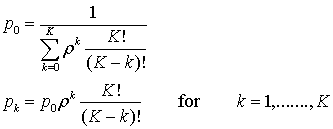
The state probabilities for this queue may be derived as before and are given by the following.
Delay Analysis for a FCFS M/M/1/∝ Queue
We had calculated the mean delays for this queue earlier - both the mean time spent in the system as well the mean time spent waiting prior to service. We now try to find the actual probability distributions (i.e. the probability density function or pdf ) of the corresponding random variables.
Let W be the random variable representing the total time spent by a job in the system (waiting and in-service) with probability density function (pdf) fW(t), cumulative distribution function (cdf) FW(t), and the Laplace Transform of the pdf as LW(s) = LT{fW (t)}.
Similarly, let Q be the random variable representing the time spent waiting for service by an arrival to the system. For this, the probability density function (pdf) is fQ(t), the cumulative distribution function (cdf) is FQ(t), and the Laplace Transform of the pdf is LQ(s) = LT{fQ (t)}.