3. Combination Pump
There are two basic requirements for load lifting or load applying by a hydraulic ram. First, there is a need of large volume of fluid at a low pressure when the cylinder extends or retracts. The low pressure is required to overcome the frictional resistance. The second requirement is that a high pressure is needed, when the load is gripped.
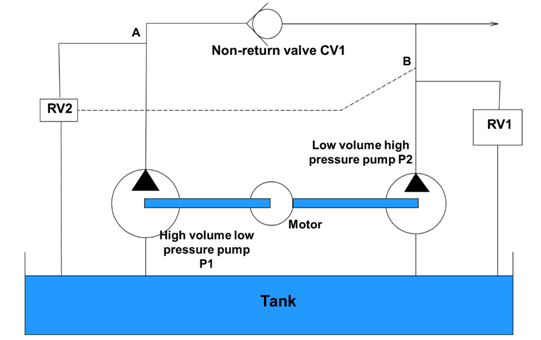
Figure 5.3.9 Combination pump
This type of requirements can be fulfilled by an arrangement as shown in figure 5.3.8. In this system two separate pumps are driven by a common electrical motor. Pump P1 is a high pressure low volume pump and pump P2 is a high volume low pressure pump. The hydraulic system is associated with relief valves RV1 and RV2 and a one-way check valve CV1. This kind of arrangement allows the fluid flow from left to right, but blocks in the reverse direction.
The pressure relief valve RV1 is a normal high pressure valve. The pressure relief valve RV2 is not operated by the pressure at point A, however, it is remotely operated by the pressure at point B. This can be achieved with the balanced piston valve. In low pressure mode both relief valves are closed and both pumps P1 and P2 deliver fluid to the load but the majority comes from the pump P2 as its capacity is higher.
When the load is in the holding mode, the pressure at B rises and relief valve RV2 opens. It results in all the fluid from pump P2 to return straight to the tank directly and the pressure at A to fall to a low value. The check valve CV1 stops the fluid from pump P1 pass it back to the tank via relief valve RV2, consequently pressure at B rises to the level set by relief valve RV1.
This kind of arrangement saves energy as the large volume of fluid from pump P2 is returned to the tank at a very low pressure, and only a small volume of fluid from pump P1 is returned at a high pressure.
In general the applications of Hydraulic Pumps can be summarized as,
- Hydraulic pumps are used to transfer power via hydraulic liquid. These pumps have a number of applications in automobiles, material handling systems, automatic transmissions, controllers, compressors and household items.
- The hand operated hydraulic pump is used in a hydraulic jack where many strokes of the pump apply hydraulic pressure to lift the ram.
- A backhoe uses an engine driven hydraulic pump to drive the articulating parts of the mechanical hoe.
- The hydraulic pumps are commonly used in the automotive vehicles especially in power steering systems.
- The lift system of tractor is operated by the hydraulic pumps. These are used in automatic transmissions and material handling systems in industries.
- Many precise controllers are developed by using hydraulic pumps. The commonly used compressor is operated by reciprocating pumps.
- The hydraulic pumps are also used in routine household systems like power lift and air-conditions. Therefore, it can be said that the hydraulic pumps have significant applications in industries as well as ones routine life.