1.3 Adjustable vane pump
The proper design of pump is important and a challenging task. In ideal condition, the capacity of a pump should be exactly same to load requirements. A pump with larger capacity wastes energy as the excess fluid will pass through the pressure relief valve. It also leads to a rise in fluid temperature due to energy conversion to the heat instead of useful work and therefore it needs some external cooling arrangement. Therefore, the higher capacity pump increases the power consumption and makes the system bulky and costly. Pumps are generally available with certain standard capacities and the user has to choose the next available capacity of the pump. Also, the flow rate from the pump in most hydraulic applications needs to be varying as per the requirements. Therefore, some vane pumps are also available with adjustable capacity as shown in figure 5.3.4. This can be achieved by adjusting a positional relationship between rotor and the inner casing by the help of an external controlling screw. These pumps basically consist of a rotor, vanes, cam ring, port plate, thrust bearing for guiding the cam ring and a discharge control screw by which the position of the cam ring relative to the rotor can be varied. In general, the adjustable vane pumps are unbalanced pump type.
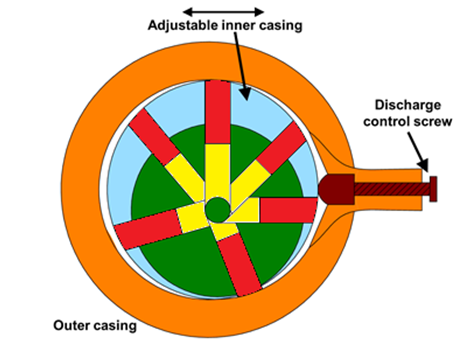
Figure 5.3.4 Adjustable vane pump
The amount of fluid that is displaced by a vane pump running at a constant speed is determined by the maximum extension of the vanes and the vanes width. However, for a pump running in operation, the width of vanes cannot be changed but the distance by which the vanes are extended can be varied. This is possible by making a provision for changing the position of the cam ring (adjustable inner casing) relative to the rotor as shown in figure 5.3.4. The eccentricity of rotor with respect to the cam ring is adjusted by the movement of the screw. The delivery volume increases with increase in the eccentricity. This kind of arrangement can be used to achieve a variable volume from the pump and is known as variable displacement vane pump.
In general, the adjusted vane pumps are pressure compensated. It means that the discharge is controlled by pre-adjusted value and when the discharge pressure reaches a certain (adjusted) value; the pumping action ceases. This mechanism is accomplished by using a compensating spring to offset the cam ring. Initially, the eccentricity is maximum because the discharge pressure is zero and spring force keeps the cam ring at the extreme right position. As the discharge pressure increases, it acts on the inner contour of the cam ring. It pushes the cam ring towards the left against the spring force and hence the eccentricity reduces and hence the discharge through the pump reduces. When the discharge pressure becomes high enough to overcome the entire spring force; the compensator spring will compress until the zero eccentricity is achieved. In this condition, the pumping action ceases and the fluid flow (except small leakages) does not occur. Therefore, the system pressure can be adjusted by setting the compensator spring. These pumps ensure their own protection against excessive system pressure and do not rely on the safety control devices of the hydraulic system. These pumps are used as energy savings devices and have been used in many applications, including automotive transmissions.