2.1.2 Swash Plate Axial Piston Pump
A swash plate is a device that translates the rotary motion of a shaft into the reciprocating motion. It consists of a disk attached to a shaft as shown in Figure 5.3.6. If the disk is aligned perpendicular to the shaft; the disk will turn along with the rotating shaft without any reciprocating effect. Similarly, the edge of the inclined shaft will appear to oscillate along the shaft's length. This apparent linear motion increases with increase in the angle between disk and the shaft (offset angle). The apparent linear motion can be converted into an actual reciprocating motion by means of a follower that does not turn with the swash plate.
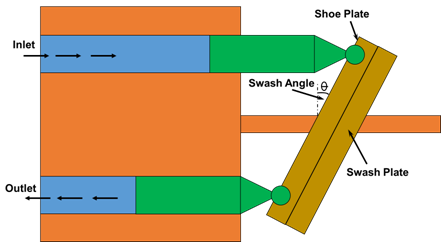
Figure 5.3.6 Swash plate piston pump
In swash plate axial piston pump a series of pistons are aligned coaxially with a shaft through a swash plate to pump a fluid. The schematic of swash plate piston pump is shown in Figure 5.3.6. The axial reciprocating motion of pistons is obtained by a swash plate that is either fixed or has variable degree of angle. As the piston barrel assembly rotates, the piston rotates around the shaft with the piston shoes in contact with the swash plate. The piston shoes follow the angled surface of the swash plate and the rotational motion of the shaft is converted into the reciprocating motion of the pistons. When the swash plate is perpendicular to the shaft; the reciprocating motion to the piston does not occur. As the swash plate angle increases, the piston follows the angle of the swash plate surface and hence it moves in and out of the barrel. The piston moves out of the cylinder barrel during one half of the cycle of rotation thereby generating an increasing volume, while during other half of the rotating cycle, the pistons move into the cylinder barrel generating a decreasing volume. This reciprocating motion of the piston results in the drawing in and pumping out of the fluid. Pump capacity can be controlled by varying the swash plate angle with the help of a separate hydraulic cylinder. The pump capacity (discharge) increases with increase in the swash plate angle and vice-versa. The cylinder block and the drive shaft in this pump are located on the same centerline. The pistons are connected through shoes and a shoe plate that bears against the swash plate. These pumps can be designed to have a variable displacement capability. It can be done by mounting the swash plate in a movable yoke. The swash plate angle can be changed by pivoting the yoke on pintles.