2.2 Radial Piston Pump
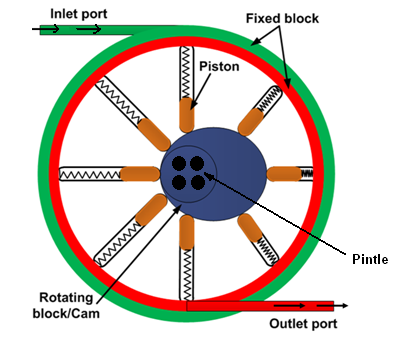
Figure 5.3.7 Radial piston pump
The typical construction of radial piston pump is shown in Figure 5.3.7. The piston pump has pistons aligned radially in a cylindrical block. It consists of a pintle, a cylinder barrel with pistons and a rotor containing a reaction ring. The pintle directs the fluid in and out of the cylinder. Pistons are placed in radial bores around the rotor. The piston shoes ride on an eccentric ring which causes them to reciprocate as they rotate. The eccentricity determines the stroke of the pumping piston. Each piston is connected to inlet port when it starts extending while it is connected to the outlet port when start retracting. This connection to the inlet and outlet port is performed by the timed porting arrangement in the pintle. For initiating a pumping action, the reaction ring is moved eccentrically with respect to the pintle or shaft axis. As the cylinder barrel rotates, the pistons on one side travel outward. This draws the fluid in as the cylinder passes the suction port of the pintle. It is continued till the maximum eccentricity is reached. When the piston passes the maximum eccentricity, pintle is forced inwards by the reaction ring. This forces the fluid to flow out of the cylinder and enter in the discharge (outlet) port of the pintle.
The radial piston pump works on high pressure (up to 1000 bar). It is possible to use the pump with various hydraulic fluids like mineral oil, biodegradable oil, HFA (oil in water), HFC (water-glycol), HFD (synthetic ester) or cutting emulsion. This is because the parts are hydrostatically balanced. It makes the pump suitable for the many applications such as machine tools (displace of cutting emulsion, supply for hydraulic equipment like cylinders), high pressure units (overload protection of presses), test rigs, automotive sector (automatic transmission, hydraulic suspension control in upper-class cars), plastic (powder injection molding) and wind energy etc.