Exercise Problems
Exercise 7.1 Obtain the following equation of motion by using the Newton's second law of motion of a rod subjected to a uniform torque T(z, t) for the pure torsional vibration. The notations have the following nomenclature: GJ as the modulus of rigidity, L is the length, is the mass density, and J is the polar area moment of inertia.

[ Hint : The free body diagram is shown in Fig. E7.1, where Tzc (z, t) is the distributed external torque on the rod, Tz (z, t) = GJφz, z is the reactive torque at the axial location of z , and  is the increment in the reactive torque from the axial location of z to ( z + dz ).
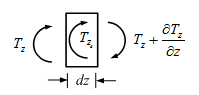
Fig. E7.1 A free body diagram of an element with a distributed torque
With the help of above free body diagram the equation of motion could be obtained].
Exercise 7.2 A cantilever rod has a thin rigid disc (of mass M with r as the radius of gyration) at free end and also it is supported by a torsional spring of stiffness k t at the free end (See Fig. E7.2). Let us taje GJ as modulus of rigidity, L is the length, Ip ( z ) = ρJ as the mass polar moment of inertia per unit length, ρ is the mass density, and J is the polar area moment of inertia. Write down equations of motion and boundary conditions for torsional vibrations. Obtain the expressions of frequency equations and mode shapes in the closed form.
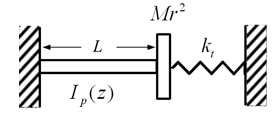
Fig. E7.2 A cantilever rod with a rigid disc and a toriosnal spring at free end.
[ Hint : Equations of motion remains the same as that of continuous rod, however, boundary condition would change due to a disc and a spring at the free end].
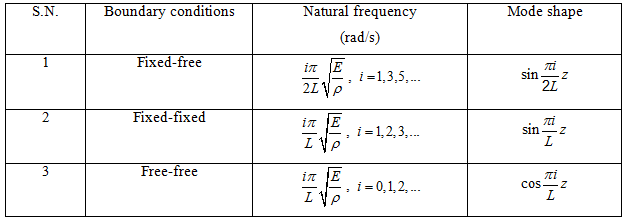
Exercise 7.3 Consider a rod with E as the Young's modulus, A is the area of the cross section, L is the length, m ( z ) = ρ A as the mass per unit length, and uz ( z ) is the axial displacement at a position z . Write down equations of motion and boundary conditions for axial vibrations . Obtain the expressions of frequency equations and mode shapes in closed form for the following boundary conditions
(i) fixed-free (ii) free-free, and (ii) fixed-fixed . 

Table E7.3 Natural frequency and mode shapes for axial vibrations of rods
Exercise 7.4 Formulate the equation of motion and the eigenvalue problem of a non-uniform rod for torsional vibrations, which is clamped at one end and free at the other end. Consider only the torsional vibrations. Let  and
and 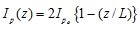 , where J° and Ip° are constant quantities. Obtain expressions of natural frequencies and mode shapes. [ Hint : equation of motion will remain the same, however, now geometrical parameters of the rod are no more constants and vary with spatial coordinate, z ].
Exercise 7.5 Obtain natural frequencies and mode shapes of the rotor system shown in Figure E7.5 for the following parameters: Ip1 = 0.02 kg-m2 , Ip2 = 0.08 kg-m2 , l = 1 m, d = 0.01 m, ρ = 7800 kg/m3 and G = 0.8 × 10¹¹ N/m2 . Use FEM (at least two elements) and compare the results by considering with and without mass of the shaft.
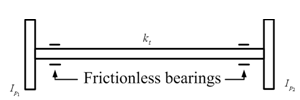
Figure E7.5 Two disc rotor system