From above equation it can be observed that both terms are always positive for positive value of μ, since the first term is a square term and the second term is positive. For a negative value of μ, the first term in the above inequality is always positive; and it is always greater than the second term. Hence for all real value of μ, above inequality is true (for imaginary values of μ we may violate the inequality however, it is not a feasible case in real systems) It means we will get always a real root from equation (5.48) when we consider a positive sign in front of the square root. For μ → 0 again equation (5.50) would be valid. For μ → ±∞ from equation (5.48), critical speeds are  → 12 and → 0, respectively, for the positive and negative signs. The above analysis is valid for the forward synchronous whirl and for the backward synchronous whirl the curve in Fig. 5.17 would be just the mirror image with respect to the vertical axis at μ = 0.
For the long stick case, it is assumed that the shaft extend to the centre of the cylinder without interference. If shaft is attached to the end of the cylinder, the elastic-influence coefficients are modified. The phenomenon described in the present section is generally referred to as a gyroscopic effect. Now with some numerical examples the calculation of critical speeds would be demonstrated.
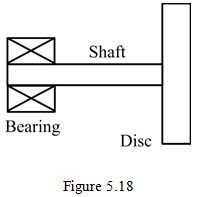
Example 5.1 Obtain the transverse critical speed for the synchronous motion of a cantilever rotor as shown in Figure 5.18. Take mass of the thin disc, m, as 1 kg with the radius, r, as 3 cm. The shaft is assumed to be massless; and its length and diameter are 0.2 m and 0.01 m, respectively. Take shaft Young’s modulus of the shaft material as E = 2.1 X 10¹¹ N/m2.
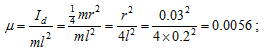
Solutions: Case I: For the disc effect μ = 0 (i.e., the concentrated mass of the disc) from equation , we have

with
 |
(a) |
Case II: Considering the disc as rigid (i.e., μ ≠ 0), from equation (5.38), we have
 |
(b) |
with
 |
(c) |
Now, from equation (5.51), we have
 |
(d) |
On substituting value of  from equation (b) into equation (d), the critical speed is given by

It should be noted that as compared to case I the critical speed is more, which is expected due to increase in the effective stiffness while considering the diametral mass moment of inertia of the disc For the present case  which is very less that is why the increase in the critical speed is marginal. Reader can check the change in the critical speed, for example, with radius of the disc equals to 6 cm. The effect would be far more predominant in the limiting case, when disc is very large that is μ → ∞, the critical speed can be calculated from equation , as

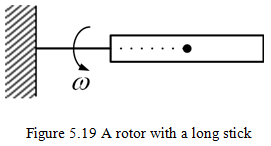
Example 5.2 Obtain the transverse critical speed for the synchronous motion of a rotor as shown in Figure 5.19. The shaft is assumed to be fixed supported at one end. Take dimensions of the cylinder (stick) as (i) D = 0.2 m, b = 0.0041 m (ii) D = 0.0547 m, b = 0.0547 m (iii) D = 0.0361 m, b = 0.1649 m and (iv) D = 0.0547 m, b = 0.1093 m. Parameters D and b are the diameter and the length of the cylinder. The shaft is assumed to be massless and its length l and diameter d are 0.2 m and 0.01 m, respectively. Take the Young’s modulus of the shaft material as 2.1 X 10¹¹ N/m2 and the density of the cylinder material as 7800 kg/m3.
Solution: For the long stick the critical speed is given as
 |
(a) |
with
 |
(b) |
Above equation is valid for all value of μ except for μ = 0 (i.e., the thin disc). For μ = 0 we have the relation given by equation (5.40) and it is given as
 |
(c) |
with
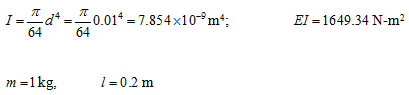
Hence, for μ = 0 (thin disc), we have
 |
(d) |
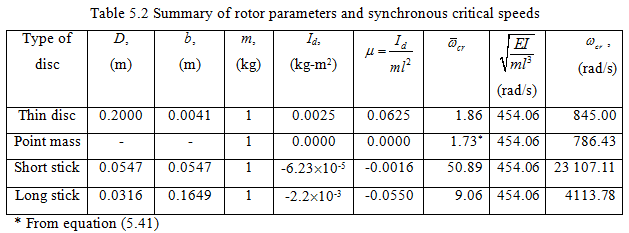
Table 5.2 summarises the calculation of rotor parameters and critical speeds from the above equations. It should be noted the choice of the D and b are such that the mass of the disc remains the same for all cases. For the point mass parameters D and b are not defined. On comparing the cases of point mass and thin disc, the increasing trend in the critical speed is observed. For short stick (with D = b) the disc parameter, µ, becomes negative with a very low value. This leads to very high value of critical speed. However, for the long stick again the trend is towards decrease in critical speed, where the disc parameter, µ, remains negative with a relatively high value.