Let the disc (or the spin axis) precession angle is Δφ from z-axis in the y-z plane as shown in Figure 5.5(a). The angular momentum will change from H (i.e., OC) to H' (i.e., OD), which can be written as (see the triangle ∆OCD which is in y-z plane)
 |
(5.4) |
where ∆H is the change in angular momentum (i.e., CD). It is due to change in the direction of H. From ∆OCD, we have

with

Noting above expression, now the rate of change of the angular momentum can be written as
 |
(5.5) |
where v is the uniform angular velocity of precession (or whirl frequency), and M is the gyroscopic moment. The gyroscopic moment will have same sense and direction as ∆H, i.e. (in the negative y-axis direction) In the vector form, equation can be written as
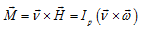 |
(5.6) |
From the right hand screw rule, we will get the direction of gyroscopic moment, i.e. along negative y-axis (the clockwise direction when seen from above, see Figure 5.5a). This is the moment exerted on the disc by the shaft in negative y-axis direction (by action) and the reaction moment on the shaft by the disc will be opposite (i.e., positive y-axis direction). Whenever an axis of rotation or spin axis changes its direction about another orthogonal axis then a gyroscopic moment acts about the third orthogonal axis. This is active moment acting on the disc, which means disc will experience this moment (as inertia moment). The support will also experience the same active moment. In other word, if to a spinning disc a moment, M, is applied (as shown in Fig. 5.5a) then precession take place in an attempt to align the angular momentum vector, Ipω, with the applied moment vector (i.e., H will try to align itself towards negative y-axis direction).
If we consider the free body diagram of the disc as shown in Fig. 5.5b, the reaction from the shaft on to the disc-hub will be the active moment (i.e., in the negative y-axis direction). Hence, the shaft will experience a reactive moment from the disc hub in the opposite direction as the active moment (i.e., in the positive y-axis direction). Let F be a force on the shaft from the bearing, then its direction due to gyroscopic moment will be as shown in Fig. 5.5(c). A reactive moment will be experienced by bearings through the shaft in the opposite direction as the active gyroscopic moment on to the disc (i.e., a couple due to –F forces).
5.2.2 Gyroscopic moments though Coriolis component of accelerations
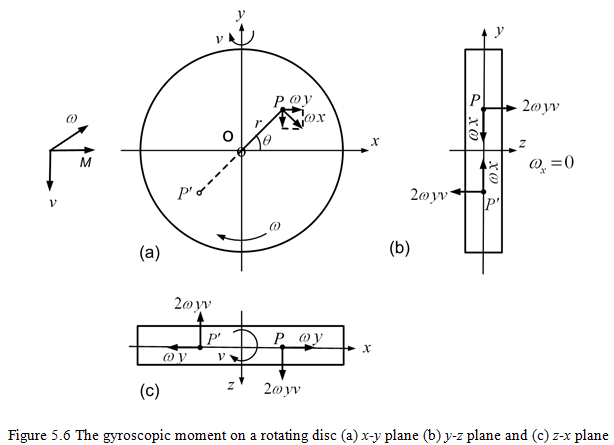
Figure 5.6 shows a disc that is spinning with a angular velocity, ω, and a precession angular velocity, v. Let z and y be the spin and precession axes, respectively (as shown in Fig. 5.6). It is assumed here that the disc has a precession only about a single axis (i.e., in negative y-axis). An infinitesimal mass, dm, at point P has coordinates (r,θ) in polar coordinates or (x, y) in rectangular coordinates. From Figure 5.6(a), it can be seen that the velocity of point P, i.e. ωr, will be perpendicular to OP. The velocity component along x-axis will be ωr sinθ = ωy and whereas along the y-axis is ωr cosθ = ωx (signs are taken care of in diagrams by its directions, hence, it is not mentioned with magnitudes of velocity vectors). Particle P has the motion along the x-axis (i.e., parallel to the x-axis) and simultaneously it is rotating about y-axis as shown in Figure 5.6(c). Hence, a Coriolis component of acceleration, i.e.  , acts along positive z-axis direction (Figures 5.6(a) and (b)).
Similarly for particle P', the Coriolis acceleration component will be ; and it acts along negative z-axis direction as shown in Figures 5.6(a and b). The force due to Coriolis component of acceleration of the particle P is given as
 |
(5.7) |
Let us first consider the moment about x-axis, and due to the particle P it is  , hence the total moment about x-axis will be
 |
(5.8) |
with
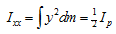 (for thin disc) (for thin disc) |
(5.9) |
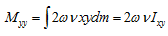
where Ip (or Izz) is the polar moment of inertia of the disc. The component of the gyroscopic moment, Mxx, acts along the positive x-axis direction (Fig. 5.6(a) and (c)). Now consider the moment about y-axis and due to the particle P it is  , hence the total moment about y-axis will be
 |
(5.10) |
with
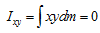 (for symmetric disc) (for symmetric disc) |
(5.11) |
It should be noted that if the disc were not symmetric then Ixy ≠ 0, so we would get Mxx and Myy both non-zero. Hence, accelerating forces arising out of these Coriolis acceleration components due to motion of particles in x-direction, produce a net moment (or a couple)  , along positive x-axis direction only. There is no Coriolis component of acceleration when we analyze the motion of particle in the y-direction since it has no precession about x-axis, ωx = 0(i.e., since the single plane precession is assumed) as shown in Figure 5.6(b). It should be noted that the outcome (magnitude and direction) is the same as of the previous section.