Exercise 4.15 Choose a single correct answer from the multiple choice questions:
- A rigid long rotor supported on flexible anisotropic bearings can have transverse natural frequencies
- 1
- 2
- 3
- 4
- more than 4
- A rigid long rotor supported on flexible anisotropic bearings can have reversal of the orbit direction as the spin speed of the rotor is increased.
- True
- False
- For a rigid rotor mounted on fluid-film bearings would have coupling of motions in
- linear displacements (x, y) only
- angular displacements (jx, jy) only
- between the linear and angular displacements (x andjy) or/and (y andjx)
- both (a) and (b)
- For a flexible rotor (e.g., a Jeffcott rotor with an offset disc) mounted on rigid bearings would have coupling of motions in
- linear displacements (x, y) only
- angular displacements (jx, jy) only
- between the linear and angular displacements (x andjy) or/and (y andjx)
- both (A) and (B)
- For a flexible rotor (e.g., a Jeffcott rotor with disc at mid span) mounted on rigid bearings would have coupling of motions in
- linear displacements (x, y) only
- angular displacements (jx, jy) only
- between the linear and angular displacements (x andjy) or/and (y andjx)
- none of the displacement would be coupled
- For a flexible rotor (e.g., a Jeffcott rotor) mounted on flexible bearings would have coupling of motions in
- linear displacements (x, y) only
- angular displacements (jx, jy) only
- between the linear and angular displacements (x andjy) or/and (y andjx)
- all linear and angular displacement would be coupled
- Obtain the transverse natural frequency of the rotor system shown below. Take the shaft as rigid. It is assumed that it oscillates (processes) about its center of gravity while whirling (i.e., pure tilting without linear motion). The stiffness of each bearing is kb and the distance between the bearings is l. Let us assume the centre of gravity lies from right bearing at one quarter of l. The diametral mass moment of inertia of the rotor is Id. Neglect the gyroscopic effects
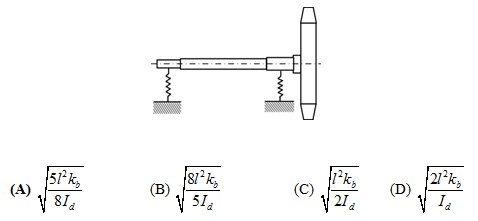
Answers: (i) D (ii) A (iii) D (iv) C (v) D (vi) D (vii) A