The total displacement of shaft ends under the action of an applied force {Fb} is given by summation of individual displacements {Xb} (by equation (4.70)) and {Xf} (by equation (4.76)), i.e.
 |
(4.77) |
where  is a system equivalent dynamic receptance matrix describing the overall shaft support characteristics and allows for flexibilities of both bearings and foundations. The study of the disc motion may now proceed in the same manner as described in the previous section except the equivalent dynamic stiffness matrix -1 should be substituted for [K]. Once the disc displacement vector {Us} is known, it is possible to substitute back and obtain {Fs}, {Xb} and {Fb}. Forces transmitted to foundations are given as
 |
(4.78) |
For the unbalance excitation, we have
 |
(4.79) |
On substituting equation (4.79) into equation (4.78), we get
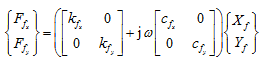 |
(4.80) |
Forces transmitted through foundations will not be the same as forces transmitted through bearings. Since bearing masses (i.e., inertia forces) will absorb some forces towards its acceleration. If bearing masses are negligible then bearings and foundations will transmit same amount of forces, however, may be with some phase lag due to damping. The amplitude and the phase of forces transmitted through foundations can be obtained from  as usual procedure described in previous sections.
More detailed study on the foundation effects is beyond the scope of the present book; however, various studies have incorporated foundation effects in a rotor-bearing system analysis and some of them are summarized here. Smith (1933) investigated the Jeffcott rotor with internal damping to include a massless, damped and flexible support system. Lund (1965) and Gunter (1967) showed that damped and flexible supports may improve the stability of high-speed rotors. Also, Lund and Sternlicht (1962), Dworski (1964), and Gunter (1970) demonstrated that a significant reduction in the transmitted force could be achieved by the proper design of a bearing support system. Kirk and Gunter (1972) analyzed the steady-state and transient responses of the Jeffcott rotor for elastic bearings mounted on the damped and flexible supports. Gasch (1976) dealt with the flexible rotating shaft of a large turbo-rotor by the finite element analysis. He introduced foundation dynamics into the rotor equations via receptance matrices, which were obtained from modal testing and modal analysis. Vance et al. (1987) provided comparison results for computer predictions and experimental measurements on a rotor-bearing test apparatus. They modeled the rotor-bearing system to include foundation impedance effects by using the transfer matrix method. Stephenson and Rouch (1992) have utilized the finite element method to analyze rotor-bearing-foundation systems. They provided a procedure using modal analysis techniques, which could be applied in measuring frequency response functions to include the dynamic effects of the foundation structure. Kang et al. (2000) studied of foundation effects on the dynamic characteristics of rotor-bearing systems. The modeling and analysis of rotor-bearing-foundation systems based on the finite element method were discussed. A substructure procedure which included the foundation effects in equations of motion and the application of the dynamic solver of a commercial package was addressed.
A good model of rotor and reasonably accurate model of fluid journal bearings may be constructed using the FE method or any other reliable method. Indeed, a number of FE based software codes are available for such modeling. However, a reliable FE model for the foundation is extremely difficult to construct due to number of practical difficulties (Lees and Simpson, 1983). Experimental modal analysis (Ewins, 2000) is a possible solution, but this requires that the rotor be removed from the foundation, which is not practical for an existing power station. With these difficulties it is unlikely that the techniques of FE model updating (Friswell and Mottershead, 1995) could be used, and the direct estimation of the foundation model from measured responses at the bearing pedestals from machine run-down data has been accepted as a viable alternative technique (Lees, 1988 and Smart et al., 2000). The estimation technique assumes that the state of unbalance is known from balancing runs, either by the difference in the response from two run-downs, or by the estimated unbalance from a single run-down (Edwards, 2000 and Sinha et al., 2002).
Concluding Remarks
In the present chapter, we dealt mainly with dynamic responses (critical speeds and unbalance responses) of a single mass rotor with flexible supports. Dynamic parameters of supports not only provide the stiffness and damping forces to the rotor, but it also provides asymmetry in these dynamic parameters in two orthogonal directions. The translatory and conical whirl motions are resulted in for the long rigid rotor supported on anisotropic bearings. It is found that the orbit of the shaft center not only becomes elliptical but its major axis becomes inclined to both orthogonal axes. The forward and backward whirls are observed of the rigid rotor mounted on anisotropic bearings. The flexibility of the foundation resulted in increase in the effective flexibility experience by the rotor system, which is expected to decrease the critical speeds. Overall complexity of the dynamic analysis procedure becomes cumbersome while considering bearings and foundations even with a single mass rotor. It demands more systematic methods for the dynamic analysis of multi-mass rotors. In subsequent chapters, while considering the torsional and transverse vibrations of multi-DOF rotor systems two representative methods called the transfer matrix method (TMM) and the finite element method (FEM) will be dealt in detail. In the next chapter we will still consider a single mass rotor only, however, now the effect of gyroscopic moments would be included.