|
Methods to derive Dynamical equations: |
|
Formulation using Lagrange equation
|
|
Newton's method
|
|
Lagrange Method:- |
|
Features: |
|
This Method is based on energy. |
|
Equations are obtained without considering the internal reaction forces. |
|
It is ideal for more complex robotic manipulator configurations. e.g. Complex 3D robot, flexible link robot
. |
|
It is better than Newton's method for robotic applications. |
| |
It is based on differentiation of energy terms with respect to the systems variables & time. In this method we have to form the Lagrangian of the system, which is the difference of kinetic & potential energy of the system. |
| |
L = K.E.- P.E.
L= Lagrangian , K.E.= Kinetic Energy, P.E.= Potential Energy.
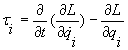
 = external force or torque applied to the system at joint i to drive link i in direction of generalised co-ordinate q i . = external force or torque applied to the system at joint i to drive link i in direction of generalised co-ordinate q i .
q i =generalised co-ordinate which may be joint angle  for revolute joint or offset distance d i for revolute joint or offset distance d i
(Please refer D-H representation.) |
| |
1. |
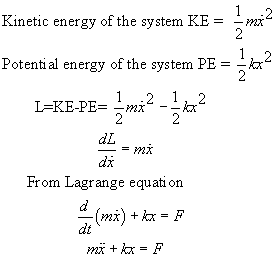
Now we will apply this method to simple systems like spring-mass system. |
| |
Figure 31.5 Spring- mass system |
|
|
| |
Contd... |