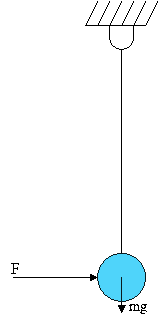
Now consider the case of simple pendulum of mass m. Let us apply a force F whose line of action will be always perpendicular to string & whose magnitude is less than weight of Bob of pendulum .
What will happen? As there is no resisting force in the mean position, pendulum starts rotating about hinge. But as soon as it leaves its mean position, resisting force which is a component of self weight of bob comes into picture. As the angle increases its magnitude increases. At some angle let say , these two forces will balance each other. , these two forces will balance each other.
F=mgsin
Suppose the task is to move the pendulum by an angle from mean position , then with the help of above equation we can find out what should be the magnitude of applied force. (Step 1)
How to apply that amount of force accurately? Think over it. Answer to this question will be given in end of this section.
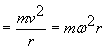
In between these two equilibrium positions, if one wishes to find out velocity & acceleration of bob, then one can use
.gif) or or
1.gif)
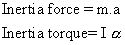
Above equations are called dynamical equations. These are ordinary differential equations. By solving them for given initial conditions one can find out velocities, accelerations at various positions. One thing to mention is that the term ma or  appearing in above equation is inertia force or inertia torque about which we will have some insight in coming part of this lecture. appearing in above equation is inertia force or inertia torque about which we will have some insight in coming part of this lecture. |