Module 9 : Robot Dynamics & controls
Lecture 31 : Robot dynamics equation (LE & NE methods) and examples
Coriolis component of acceleration:
 
Figure 31.4 Coriolis Acceleration

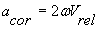
Till now we have discussed simple examples of linear motion (i.e sliding block) & angular motion( i.e Pendulum). Now we will consider one simple example where both linear & angular motions are involved. Consider a link OB hinged at O rotating in clockwise direction with angular velocity . Consider a block sliding relative to the link with constant speed . Sliding block experiences an acceleration whose direction is given by rotating the relative sliding velocity vector by 90 ° in the sense given by angular velocity of link. This acceleration is known as Coriolis component of acceleration.

Its magnitude is given by


WHY CORIOLIS COMPONENT OF ACCELERATION EXIST ?

Once again consider above example. Link OB is performing pure rotation. Anything attached to it will have velocity corresponding to tangential velocity at that attached point. Block can be considered as attached to link & its attachment point varies as it moves along link. Block is having two velocity components one is along link which is constant & other is perpendicular to link which is a function of block position along the link. As block moves along link ,its velocity component perpendicular to link changes.This corresponds to Coriolis component of acceleration.

Velocity change in limiting case will be perpendicular to the link. Hence Coriolis component of acceleration will be always perpendicular to link.


Why to study Robot Dynamics & Control?

Basically a Robot manipulator is a positioning device. .Any task specified to it is finally converted to Regulation problem or Trajectory tracking problem.

Suppose the task is to pick an object from one point & place it to another place, this is a regulation problem. (i. e. point-to-point motion problem) & if there is a constraint that while moving from one point to another, it should follow a particular path then it will be trajectory tracking problem(continuous path).

Whatever may be the type of problem, this can be further divided into two steps. First step is related with finding out force/torque requirement which needs dynamical equations of Robot manipulator & second step is related with supplying proper amount of force/torque at joint which needs to control input to actuator.

Study of Robot Dynamics gives dynamical equations of Robot manipulator which will help in finding out these torque requirements. It is the actuator which is going to satisfy the requirements imposed by Robot manipulator.Hence these equations are coupled with Actuator dynamics.

By studying Robot Control one can develop a control system & algorithm as per performance requirement. With the help of that we can control input to actuator as per requirement.

Hence study of Robot Dynamics & Control module is very important.

To derive robot dynamical equation first kinematic analysis has to be carried out. Then we can use two methods to get the governing equations of dynamics which are explained in next part of this lecture.

4