Module 9 : Robot Dynamics & controls
Lecture 31 : Robot dynamics equation (LE & NE methods) and examples
  Fundamentals of Dynamics:
 

While Kinematics deals with finding position, velocity & acceleration based on geometrical constraints, dynamics is concerned with solving for these when an external force acts on the system or the system is released to evolve from some initial position(e.g. Pendulum).

Now we will consider some simple examples to make clear understanding of dynamics.

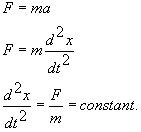
Consider a block sliding on the frictionless floor. A force of constant magnitude F is applied to block. Dynamical equation can be easily found out in this case.Basically dynamical equations are mathamatical model governing dynamic behaviour of system.These equations are the force-mass-acceleration or the torque-inertia-angular acceleration relationships. By knowing the magntude of applied force & mass of block, velocity & acceleration can be easily found out at every instant of time if we know initial conditions such as whether body is at rest or moving with certain velocity.


Figure 31.1 Sliding Block

Dynamical equation

  Suppose the task is to move the block from one position to other with condition on its velocity plot w.r.t time. (While moving from one position to other, it's velocity plot w.r.t time should be as shown in the fig.) We will divide this task into two steps. First step is related with finding out force requirement & second step related with application of requisite amount of force. Reason for dividing the task into two steps will be made clear in later part of this lecture.
 

First step:

Force requirement can be easily found out using dynamical equation.

                                             F=m.a

(Acceleration can be found out from velocity profile w.r.t. time. )

For moving from O to A, a constant magnitude accelerating force should be applied. For moving from A to B , no force should be applied & for moving from B to C a constant magnitude retarding force should be applied. How to apply this kind of force? Think over it. Answer to this question will be given in end of this section.

Figure 31.2 Velocity profile w.r.t. time


Contd...

2