| 14.5 |
Types of Fuses |
| 2. |
Vacuum Fuse |
| |
Vacuum fuse is a non expulsive fuse but still a current zero awaiting type. The design, operation and current-voltage-time relationship of this fuse closely matches with that of an expulsion fuse. The main difference is that it is a completely sealed unit and no expulsion action. Interruption occurs because of rapid dielectric build up that occur in a vacuum after current zero is reached. |
| 3. |
Current Limiting Fuse |
| |
Suppose that an overcurrent protective element could insert a large resistance in series during fault current. This would then improve the power factor in the fault circuit which otherwise is more or less inductive. Thus, the zero crossing of the current and voltage would be in phase. This implies that when the arc is extinguished temporarily at current zero, the applied voltage across it will also be zero. This should be contrasted with expulsion type or current awaiting type fuse where typically, I(t) = 0, V = Vm. ( phase lag in an inductive circuit). If at current zero, V(t) = Vm, then the presence of a large electric field does not help in quick de-ionization. In contrast, when the current zero and voltage zero are in phase, then when the temporary arc is extinguished, the dielectric medium will be quickly de-ionized. (This also reduces TRV. Inclusion of higher resistance also reduces peak value of current.) |
 |
|
|
| |
 |
This leads to speeding in fuse action. The primary question however, is how to insert the high resistance in series. Basically, the current limiting fuses attempt to constrict the arc and it is cooled by sand.
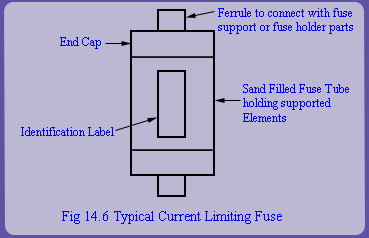
A typical current limiting fuse is shown in fig 14.6. In this case, the fusible element is very long. The element is completely surrounded with filler material, typically silica sand, to contain the arc as well as maintain a very high pressure in the long restricted arc area caused by the practically simultaneous melting of the full length of element. This then allows the fuse to produce a very high resistance in the circuit in a very short period of time (typically hundreds of µsec). |
| |
|
|
|

