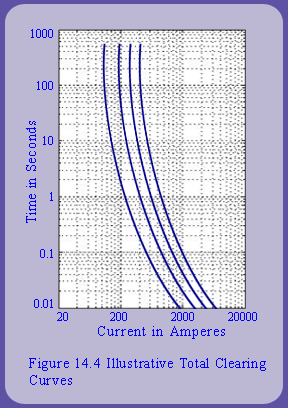
It is important to realize that power apparatus and systems contain inductive elements. Hence, melting of a fusing element is not sufficient to interrupt the current. Consequently, there is always some period of arcing before the current is interrupted. During this period, fuse must withstand any immediate transient voltage condition and subsequent steady state recovery voltage. Addition of melting time and this arcing overhead gives the total clearing time.
Total clearing TCC curve (fig 14.4) describes this information. For lower currents, melting time can be large and arcing time small because of lower stored energy in induction circuit. In contrast, for large currents, melting time is small but the arcing time is large. Hence, TCC for melting time and total clearing time diverges as increases.
Both of these characteristics are required to coordinate back up fuse or overcurrent relay or any other protective devices. Back up device should provide sufficient 'opportunity window' (time) to primary fuse to clear the fault. This ensures selectivity. Recall that selectivity minimizes loss of service.
14.4.3
Very Inverse Melting Characteristic
Fuse melting time characteristic is usually described in literature as “very inverse”. To understand this, we need to address the physics of the problem. When overcurrents are smaller in magnitude, rate of heat generated in the element is low and only slightly higher than rate of dissipation. As a consequence, temperature of the element increases gradually. As the current increases, melting time reduces at a rate which is more than expected increased rate of heat generation (I2R). This is because, heat which is generated in reduced cross section and/or centre of element, cannot be removed as fast as it is produced. This gives fuse a very inverse characteristics. At very short melting times, no heat is lost from the smaller cross section of the element.

 in induction circuit. In contrast, for large currents, melting time is small but the arcing time is large. Hence, TCC for melting time and total clearing time diverges as
 increases.

