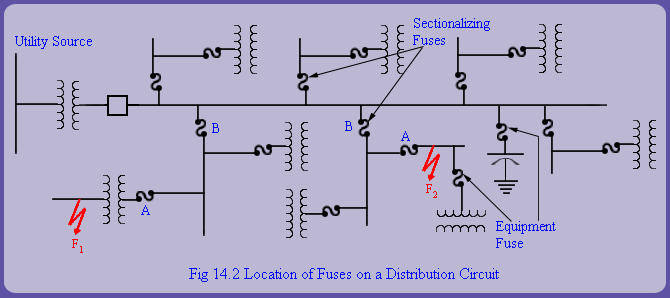
Terminology ‘Fuse' does not require any introduction. A ‘fuse' refers to a device that opens a circuit with fusible part, which is heated and severed by current flowing through it. The fusible part is also called the “Element”. When current flows in a fuse, heat is generated and the element temperature rises. If the current is within (less or equal to) its continuous rated value, then the steady state temperature is such that the fuse does not melt. However, if the current has large enough magnitude, it will lead to the fuse element to melt before the steady state temperature conditions are achieved. After melting, an arc may be struck. The fault current will be finally interrupted when the arc is de-ionized. Thus, fuse operation involves two phases viz. melting and current interruption.
An enormous variety of fuses are available today. In terms of quantity, fuses outnumber any other over current protection devices. They provide economy in protection as well as flexibility in rating and time current characteristic. They are used for overcurrent protection of transformers, capacitors and lateral taps in distribution systems. |