The expulsion type fuse is used where expulsion gases cause no problem such as in overhead circuits and equipment. These fuses can be termed as current awaiting types; and the function of interrupting medium is similar to that of an ac circuit breaker. The temperature of arc is of the order of 4000-5000K. At this temperature special materials located in close proximity to fuse element rapidly create gases. Preferred gas generating materials are fiber, melamine, boric acid and liquids such as oil or carbon tetrachloride. These gases help to create a high pressure turbulent medium surrounding the arc, thus when the current does reach to zero and the arc channel reduces to a minimum; the ablated gases rapidly mix with remaining ionized gas and thereby deionize them as well as remove them from ‘arc area'. In turn, this leads to rapid build up of dielectric strength that can withstand the transient recovery voltage (TRV) and steady state power system voltage.
TRV for expulsion fuse is shown in fig 14.5. Note that in an inductive circuit, current zero occurs at lag to voltage i.e. when voltage is at maximum value. The action of interrupting medium causes TRV to be seen in this region.

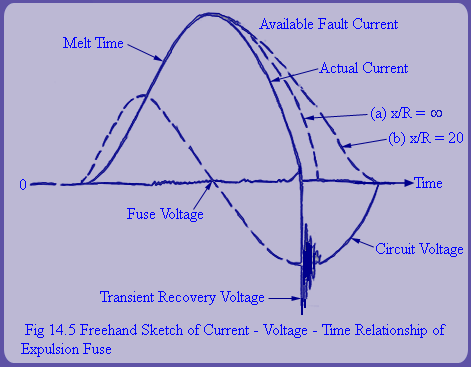
 lag to voltage i.e. when voltage is at maximum value. The action of interrupting medium causes TRV to be seen in this region.

