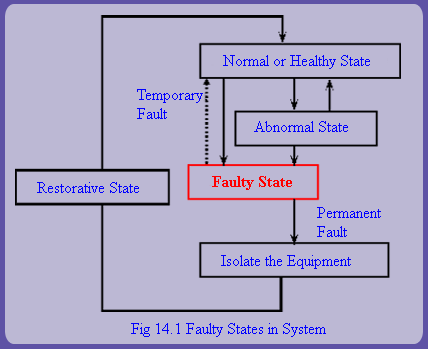
| When an equipment (e.g. transmission line, transformer, generator, motor) is operating within the rated specifications (speed, voltage, current etc.), we say that it is in the normal state. Therefore, abnormal state pertains to deviation from the rated operating point. It may refer to overcurrent, under voltage, over or under frequency. If the apparatus continues to operate in this state for long enough time, it can lead to damage or reduction in life of the equipment. On the other hand, it may be also unsafe to operate in this region. A fault refers to a serious abnormality which typically requires immediate deenergization of the equipment.
Usually, faults are considered dangerous because of overcurrent that they create. This can damage the apparatus and it endangers the human safety. Three phase faults, Line to Line faults (LL), Single Line to Ground fault (SLG), Line to Line Ground faults (LLG) are some standard faults considered in our analysis. Three phase faults and Line to Line faults are also known as phase faults while Single Line to Ground and Double Line to Ground faults are also known as ground faults. However, not all faults create large overcurrents. For example, earth faults which may result due to partial insulation failure may not create large currents. However, it makes operation of the equipment unsafe from human safety perspective and further, if the fault is left unattended it can aggravate. |