Fuses are characterized by ‘thermal' and 'interrupting' characteristics. Thermal characteristic are quite intuitive and relate to the following:
Current rating.
Melting characteristics.
Interrupting characteristics refer to the following:
Voltage rating.
Interrupting rating.
14.4.1
Thermal Characteristics
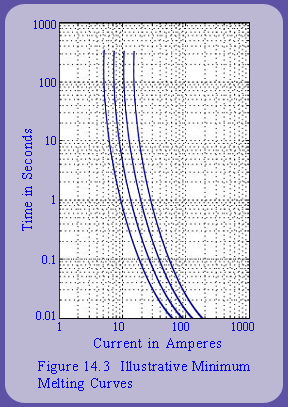
As the magnitude of the current increases, melting time reduces. It should be obvious that larger magnitude currents will lead to higher power dissipation (I2R) in the fuse and hence faster rise in temperature of the element. This would imply that melting time of the fuse should be inversely proportional to magnitude of square of current. The relationship between the magnitude of the current that causes melting and the time needed for it to melt is given by the fuse's melting time current characteristics (TCC). To cover a wide range of currents and operating time, TCC is plotted on a log-log paper.
The current is the symmetrical current. The current on x-axis is the symmetrical current. It does not involve dc offset current. Further, fuse does not carry initial current and ambient temperature is between C and C (IEEE Std 37.41-1994). Since, the melting time vary in a range, minimum melting time curve is plotted as shown in fig 14.3.
The severing of fuse element is a primary consequence of thermal effect. It does not depend upon mechanical forces, inertia etc. Thus there is no limit on how short the melting time can be. This extremely small melting (fast operation) of a fuse at very high currents tends to distinguish it from most other protective devices.


 C and
 C (IEEE Std 37.41-1994). Since, the melting time vary in a range, minimum melting time curve is plotted as shown in

