The Indian system is a topocentric
system (a geodetic
system whose origin would be located at a point on the surface
of the earth) which is realized by
Choosing an initial point (origin)
Specifying, the latitude and longitude of the initial point
Azimuth of a line from this point
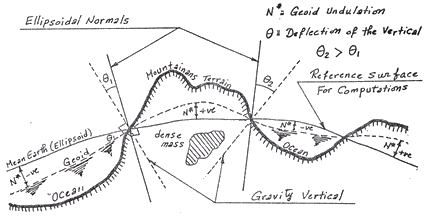
Two parameters of a reference ellipsoid (Figure 8.7):
Deflection of vertical (theta, the spatial angle
between geoidal normal and ellipsoid normal at a
point)
Geoidal undulation at the initial point (N*)
Indian Geodetic datum, using Everest ellipsoid is a local
geodetic datum, which best fits to certain extent the Indian
subcontinent. It is non-geocentric ellipsoid and its origin
is far away from the geocentre (C. G. of the Earth).
The geodetic coordinates based on Everest ellipsoid differ
considerably (in many cases even hundreds of meters) as compared
to WGS-84 and other International ellipsoids.
Figure 8.7 Deflection of vertical and Geoidal undulation
(Nassar, 1994)
Details of the Indian topocentric system (Agrawal, 2004)