Recall the
principle of EDM (Schoffield, 2001;
Module 1 of these notes) where the phase measurement
was explained. A modified approach is
used in GPS measurements which is a one-way measuring system.
In GPS, the measured quantity is the difference between the
received satellite carrier phase (as sensed by the receiver
antenna) and the phase of the internal receiver oscillator.
Phase measurement have high accuracy: 3 - 10 mm.
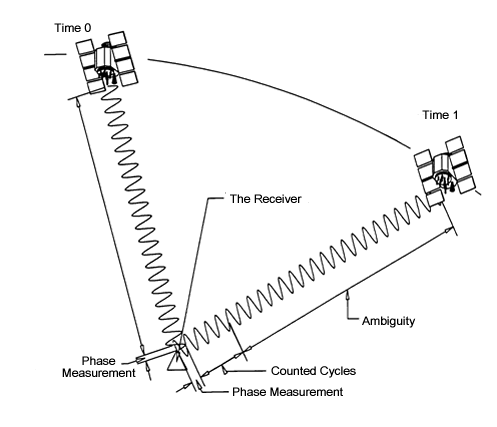
In carrier phase based measurement, receiver measures the
fraction of one wavelength when it first locks onto a satellite
and continuously measures the carrier phase from that time.
However, receiver is not able to measure the complete range
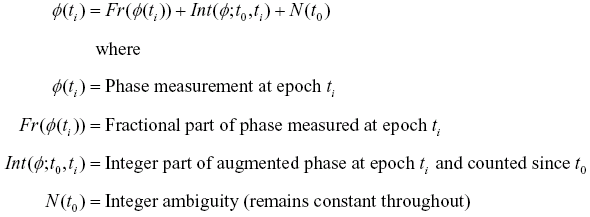
directly. The total pahse measured at a given epoch (instant)
(t0) is given by a combination of a fractional phase (which
is measured by receiver), integer number of cycles, N (which
is unknown). The number of cycles between the satellite and
receiver at initial start up (referred to as the integer
ambiguity or
ambiguity) and the measured
carrier phase together represent the satellite-receiver range
(i.e. the distance between a satellite and a receiver). As
long as the lock on a particular GPS satellite is maintained,
the ambiguity remains constant and can be solved by numerical
techniques (these techniques will not be explained in this
course).
At the initial epoch (instant) f the GPS signal, (t0),
only the fractional of a cycle of the beat phase is measured
by the receiver, where one cycle corresponds to one wavelength.
The remaining integer number of cycles (integer ambiguity,
indicated by N(t0)
to the satellite cannot be measured directly. But as long
as there is no loss of lock, N(t0) remains constant. Thus the measured phase at an epoch (ti)
can be written as (Abidin, 2002):
|