| |
| | |
|
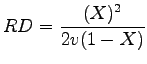
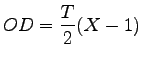
As explained earlier random and overflow delay is given as,
Random delay,
 |
(1) |
Overflow delay,
 |
(2) |
Figure 1:
Comparison of overflow & random delay model
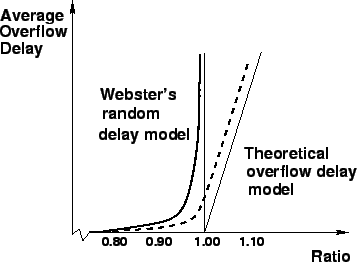 |
The inconsistency occurs when the  is in the vicinity of 1.0.
When is in the vicinity of 1.0.
When  random delay model is used.
As the Webster's random delay contains 1-X term in the denominator, when
approaches to 1.0 random delay increases asymptotically to infinite value.
When random delay model is used.
As the Webster's random delay contains 1-X term in the denominator, when
approaches to 1.0 random delay increases asymptotically to infinite value.
When  overflow delay model is used.
Overflow delay contains overflow delay model is used.
Overflow delay contains  term in the numerator, when approaches to 1.0
overflow becomes zero and increases uniformly with increasing value of .
Both models are not accurate in the vicinity of term in the numerator, when approaches to 1.0
overflow becomes zero and increases uniformly with increasing value of .
Both models are not accurate in the vicinity of  .
Delay does not become infinite at .
There is no true overflow at , although individual cycle failures due to
random arrivals do occur.
Similarly, the overflow model, with overflow delay of zero seconds per vehicle at is also
unrealistic.
The additional delay of individual cycle failures due to the randomness of
arrivals is not reflected in this model.
Most studies show that uniform delay model holds well in the range .
Delay does not become infinite at .
There is no true overflow at , although individual cycle failures due to
random arrivals do occur.
Similarly, the overflow model, with overflow delay of zero seconds per vehicle at is also
unrealistic.
The additional delay of individual cycle failures due to the randomness of
arrivals is not reflected in this model.
Most studies show that uniform delay model holds well in the range
 .
In this range true value of random delay is minimum and there is no overflow
delay.
Also overflow delay model holds well when .
In this range true value of random delay is minimum and there is no overflow
delay.
Also overflow delay model holds well when
 .
The inconsistency occurs in the range .
The inconsistency occurs in the range
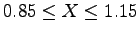 ; here both the models are not
accurate.
Much of the more recent work in delay modeling involves attempts to bridge this
gap, creating a model that closely follows the uniform delay model at low X
ratios, and approaches the theoretical overflow delay model at high X ratios,
producing "reasonable" delay estimates in between.
Fig. 1 illustrates this as the dashed line. ; here both the models are not
accurate.
Much of the more recent work in delay modeling involves attempts to bridge this
gap, creating a model that closely follows the uniform delay model at low X
ratios, and approaches the theoretical overflow delay model at high X ratios,
producing "reasonable" delay estimates in between.
Fig. 1 illustrates this as the dashed line.
|
|
| | |
|
|
|


