| |
| | |
|
The most common measure of operational quality is delay, although queue length
is often used as a secondary measure.
While it is possible to measure delay in the field, it is a difficult process,
and different observers may make judgments that could yield different results.
For many purposes, it is, therefore, convenient to have a predictive model for the estimate of delay.
Delay, however, can be quantified in many different ways.
The most frequently used forms of delay are defined as follows:
- Stopped time delay
- Approach delay
- Travel time delay
- Time-in-queue delay
- Control delay
These delay measures can be quite different, depending on conditions at the
signalized intersection.
Fig 1 shows the differences among stopped time, approach and
travel time delay for single vehicle traversing a signalized intersection.
The desired path of the vehicle is shown, as well as the actual progress of the
vehicle, which includes a stop at a red signal.
Figure 1:
Illustration of delay measures
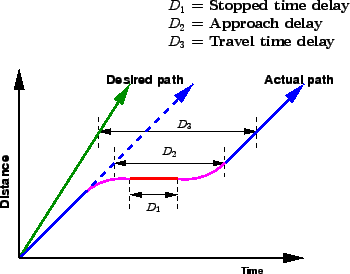 |
Note that the desired path is the path when vehicles travel with their preferred
speed and the actual path is the path accounting for decreased speed, stops and
acceleration and deceleration.
Stopped-time delay is defined as the time a vehicle is stopped in queue while
waiting to pass through the intersection.
It begins when the vehicle is fully stopped and ends when the vehicle begins to
accelerate.
Average stopped-time delay is the average for all vehicles during a specified
time period.
Approach delay includes stopped-time delay but adds the time loss due to
deceleration from the approach speed to a stop and the time loss due to
re-acceleration back to the desired speed.
It is found by extending the velocity slope of the approaching vehicle as if no
signal existed.
Approach delay is the horizontal (time) difference between the hypothetical
extension of the approaching velocity slope and the departure slope after full
acceleration is achieved.
Average approach delay is the average for all vehicles during a specified time
period.
It is the difference between the driver's expected travel time through the
intersection (or any roadway segment) and the actual time taken.
To find the desired travel time to traverse an intersection is very difficult.
So this delay concept is is rarely used except in some planning studies.
Time-in-queue delay is the total time from a vehicle joining an intersection
queue to its discharge across the STOP line on departure.
Average time-in-queue delay is the average for all vehicles during a specified
time period.
Time-in-queue delay cannot be effectively shown using one vehicle, as it
involves joining and departing a queue of several vehicles.
Control delay is the delay caused by a control device, either a traffic signal
or a STOP-sign.
It is approximately equal to time-in-queue delay plus the
acceleration-deceleration delay component.
Delay measures can be stated for a single vehicle, as an average for all
vehicles over a specified time period, or as an aggregate total value for all
vehicles over a specified time period.
Aggregate delay is measured in total vehicle-seconds, vehicle-minutes, or
vehicle-hours for all vehicles in the specified time interval.
Average individual delay is generally stated in terms of seconds per vehicle for a specified
time interval.
|
|
| | |
|
|
|


