Remarks:
• The feedforward controller ideally does not get any feedback from the process output. Hence, it solely works on the merit of the model(s). The better a model represents the behavior of a process,the better would be the performance of a feedforward controller designed on the basis of that model. Perfect control necessitates perfect knowledge of process and disturbance models and this is practically impossible. This inturn is the main drawback of a feedforward controller.
• The feedforward control configuration can be developed for more than one disturbance in multi-controller configuration. Any controller in that configuration would act according to the disturbance for which it is designed.
• External characteristics of a feedforward loop are same as that of a feedback loop. The primary measurement (disturbance in case of feedforward control and process output in case of feedback control) is compared to a setpoint and the result of the comparison is used as the actuating signal for the controller. Except the controller, all other hardware elements of the feedforward control configuration such as sensor, transducer, transmitter, valves are same as that of an equivalent feedback control configuration.
• Feedforward controller cannot be expressed in the feedback form such as P, PI and PID controllers. It is regarded as a special purpose computing machine .
• Let us consider a system where process delay is higher than disturbance delay, eg. and
and  ; in such case,
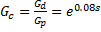 . That means one needs to know the future values of disturbance in order to decide present control action. This is physically unrealizable controller.
V.I.3 Combination of Feedforward-Feedback Controller
The following table provides a comparative assessment of feedforward and feedback controllers.
Table V.1: Merits and demerits of feedforward and feedback controllers |
|
Merits |
Demerits |
Takes corrective action before the process “feels” the disturbance |
Requires measurement of all disturbances affecting the system |
Good for sluggish systems and/or system with large deadtime |
Sensitive to variation in process parameters |
Does not affect the stability of the process |
Requires a “near perfect” model of the process |
Feedback controllers |
|
Does not require disturbance measurement |
Acts to take corrective action after the process “feels” the disturbance |
Insensitive to mild errors in modeling |
Bad for sluggish systems and/or system with large deadtime |
Insensitive to mild changes in process parameters |
May affect the stability of the process |