V.I.2 Example of design of feedforward controller
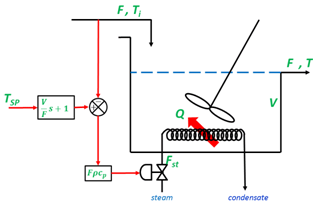
Consider an overflow type continuous stirred tank heater shown in Fig V.4. The fluid inside the tank is heated with steam whose flow rate is Fst and supplying heat at a rate of Q to the fluid. Temperatures of the inlet and outlet streams are Ti and T respectively. V is the volume of liquid which is practically constant in an overflow type reactor. A control valve in the steam line indicates that the steam flow rate can be manipulated in order to keep the liquid temperature at a desired setpoint. Temperature of the inlet stream flow is the source of disturbance (change in Ti ) to the process.
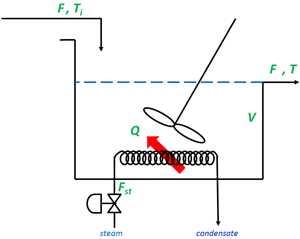
(a) Process without a controller |
(b) Process with feedforward controller |
Fig V.4: Feedforward control configuration of an overflow type continuous stirred tank heater
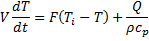
A simple energy balance exercise will yield the model equation of the above process as:
 |
(V.10) |
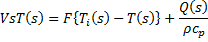
All the variables are assumed to be in the deviation form. Hence, taking Laplace transform on both sides we obtain:
 |
(V.11) |
or,  |
(V.12) |
or,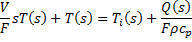 |
(V.13) |
| or, | |
 |
(V.14) |
The feedforward controller is meant for ensuring  . Hence,
|
(V.15) |
| or | |
 |
(V.16) |

Hence, one needs to set Fst in such a way that Q amount of heat as given in eq.(V.16) is transferred to the process. Fig V.4(b) represents the feedforward structure of the controller.